Cognitive Science Courses
Cognitive Science courses can help you learn about human perception, language processing, decision-making, and neural networks. You can build skills in critical thinking, data analysis, and experimental design, which are vital for understanding how the mind works. Many courses introduce tools like Python for data analysis, statistical software for research, and simulation programs to model cognitive processes, allowing you to apply your knowledge in practical settings.
Popular Cognitive Science Courses and Certifications

The University of Edinburgh
Skills you'll gain: Artificial Intelligence, Psychology, Fraud detection, Human Development, Scientific Methods, Research
University of Cambridge
Skills you'll gain: Sensory Systems Analysis, Human Learning, Psychology, Magnetic Resonance Imaging, Medical Imaging, Neurology, Research Methodologies, Research, Human Development, Learning Theory, Scientific Methods, Electrophysiology, Physiology
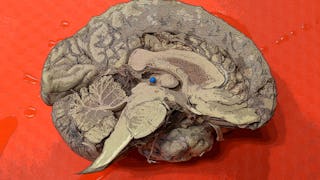
The University of Chicago
Skills you'll gain: Sensory Systems Analysis, Neurology, Psychology, Physiology, Life Sciences, Anatomy, Behavioral Health, Electrophysiology, Human Musculoskeletal System, Mental Health Diseases and Disorders, Vital Signs, Cell Biology, Language Disorders, Coordination, Biology
University of Cambridge
Skills you'll gain: Childhood Education and Development, Human Learning, Child Development, Psychology, Empathy & Emotional Intelligence, Sensory Systems Analysis, Teaching, Decision Making, Learning Theory, Instructional Strategies, K-12 pedagogy, Pedagogy, Learning Strategies, Developmental Disabilities, Empathy, Neurology, Magnetic Resonance Imaging, Electrophysiology, Human Development, Decision Intelligence

Utrecht University
Skills you'll gain: Child Development, Human Development, Childhood Education and Development, Empathy & Emotional Intelligence, Systems Thinking, Learning Theory, Research, Neurology, Research Methodologies
Arizona State University
Skills you'll gain: Problem Solving, Critical Thinking and Problem Solving, Creativity, Creative Problem-Solving, Human Factors, Creative Thinking, Decision Making, Human Learning, Complex Problem Solving, Human Computer Interaction, Mental Concentration, Human Machine Interfaces, Learning Theory, Usability, Memory Management, Human Centered Design
What brings you to Coursera today?

University of Cambridge
Skills you'll gain: Childhood Education and Development, Human Learning, Child Development, Teaching, Learning Theory, Instructional Strategies, K-12 pedagogy, Pedagogy, Learning Strategies, Developmental Disabilities, Disabilities, Autism Spectrum Disorders, Special Education, Human Development, Differentiated Instruction, Interactive Learning, Neurology, Diversity Awareness

University of Colorado Boulder
Skills you'll gain: Problem Solving, Agentic systems, Computational Thinking, Computer Vision, Game Theory, Image Analysis, Artificial Neural Networks, Probability Distribution, Decision Intelligence, Behavioral Economics, Convolutional Neural Networks, Logical Reasoning, Algorithms, Human Development, Analytical Skills, Artificial Intelligence and Machine Learning (AI/ML), Artificial Intelligence, AI literacy, Theoretical Computer Science, Psychology
Johns Hopkins University
Skills you'll gain: Sensory Systems Analysis, Marketing Psychology, Influencing, Case Studies, Persuasive Communication, Advertising, Marketing Communications, Consumer Behaviour, Decision Making, Marketing Effectiveness, Neurology, Behavioral Economics, Marketing, Psychology, Anatomy
University of Cambridge
Skills you'll gain: Human Development, Psychology, Neurology, Decision Intelligence, Psychiatry, Mental and Behavioral Health Specialties, Child Development, Mental Health Diseases and Disorders, Anatomy, Physiology, Biology

University of Washington
Skills you'll gain: Machine Learning Methods, Network Model, Electrophysiology, Applied Machine Learning, Supervised Learning, Machine Learning Algorithms, Artificial Neural Networks, Reinforcement Learning, Sensory Systems Analysis, Matlab, Mathematical Modeling, Computer Vision, Neurology, Mathematical Software, Recurrent Neural Networks (RNNs), Physiology, Biology, Differential Equations, Probability Distribution

Princeton University
Skills you'll gain: Theoretical Computer Science, Data Structures, Computer Science, Computer Architecture, Computer Systems, Algorithms, Computer Programming, Computational Logic, Java Programming, Computer Hardware, Scalability
In summary, here are 10 of our most popular cognitive science courses
- Philosophy and the Sciences: Introduction to the Philosophy of Cognitive Sciences: The University of Edinburgh
- Introduction to Cognitive Psychology and Neuropsychology: University of Cambridge
- Understanding the Brain: The Neurobiology of Everyday Life: The University of Chicago
- The science of mind and decision making: University of Cambridge
- Understanding child development: from synapse to society: Utrecht University
- Human Cognitive Capacities & Limitations: Arizona State University
- Learning and memory in the brain: a guide for teachers: University of Cambridge
- Mind and Machine: University of Colorado Boulder
- Foundations of Neuroscience: Johns Hopkins University
- The neuropsychology of decision making: University of Cambridge










